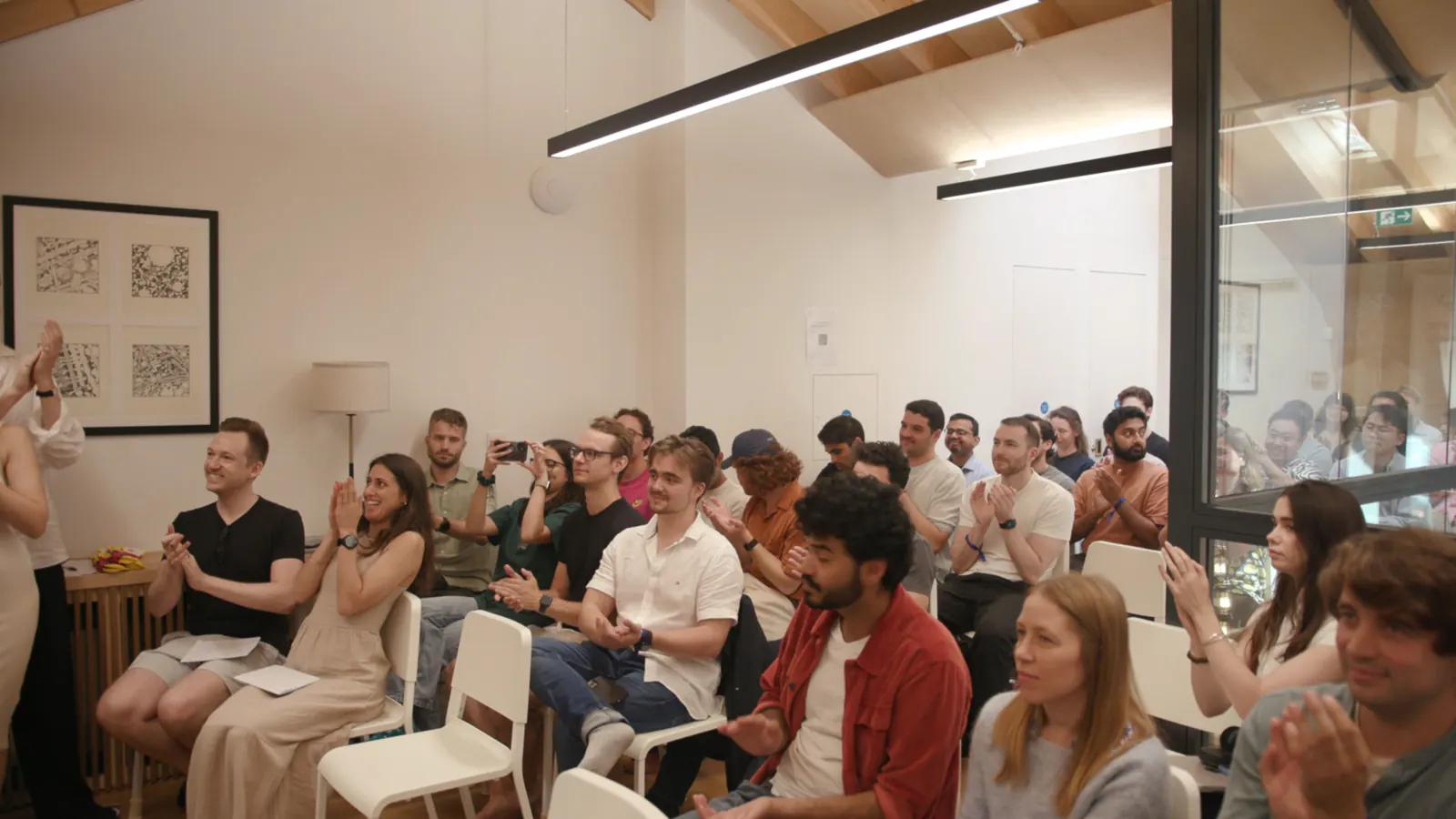












Engineers, scientists, computational biologists, founders and AI specialists came together at 50Y in Soho Square, London, from 3rd–5th July for Building an AI Scientist, a three-day hackathon focused on developing new tools for AI-powered drug discovery.
Organised by TernaryTx, future.bio, Pluto House and Anthropic, the event challenged 70 participants across fifteen multidisciplinary teams to address real-world problems spanning target identification, toxicity prediction, scientific data analysis, experimental design and molecular modelling.
The hackathon was created to explore what becomes possible when frontier AI tools are combined with deep scientific expertise and applied to practical bottlenecks in the drug-development process. Rather than focusing solely on speculative uses of AI, teams were challenged to create working tools, prototypes and open-source projects capable of supporting real scientific decisions.
The event opened with a keynote from Chris Tame, CEO and co-founder of TernaryTx, introducing the vision behind the hackathon and the potential for agentic AI to transform drug discovery. A panel discussion on The Future of AI in Drug Discovery explored how AI is changing scientific research, the most important unsolved opportunities in the sector and how teams can build meaningful projects within compressed timeframes.
On Saturday, participants formed squads and began building, supported by technical mentors, drug discovery specialists and AI and machine-learning experts. On Sunday, all fifteen teams presented live demonstrations of their work, with projects assessed against innovation, technical execution, scientific relevance, potential impact and presentation quality.
Apoptosis AI takes the top prize
The overall winning project, Apoptosis AI, focused on one of the most consequential early-stage decisions in drug development: determining whether a potential biological target is sufficiently compelling and sufficiently de-risked to pursue.
The team developed a decision-making co-pilot for pharmaceutical and biotechnology companies. The tool produces structured reports bringing together scientific evidence, safety information and associated risks relating to a potential target. It also recommends experiments that could help resolve remaining uncertainties, allowing project teams to identify what further validation is needed before significant resources are committed.
Apoptosis AI was developed by Janik Ludwig, Gopalkrishna Purohit, Jan Boltersdorf, Youssef Abdalla, Dmitry Kalupin and Axay Soni, whose combined expertise spans software engineering, biology, pharmacy, mathematics and computational biology.
The project received a £1,000 cash prize and $10,000 in AWS credits, which the team intends to use to deploy the platform through a cloud-based interface.
“We underestimated what happens when you put exceptional people in one room. Twenty-four hours in, we had something we didn’t think was possible yet. The team covered science and software end to end, and that’s what let us ship something real that fast. Winning didn’t feel like an ending. It felt like a start date.”
The Apoptosis AI team
Stratified Precision wins the People’s Choice Award
The People’s Choice Award, voted for by participants at the event, went to Halimat Afolabi for Stratified Precision.
Drawing on Afolabi’s experience as an NHS doctor and in machine-learning research across academia and the pharmaceutical industry, Stratified Precision proposes a patient-first approach to target identification.
Rather than beginning with a predetermined target, the platform starts with a patient population and uses an agentic AI pipeline to identify biologically distinct subgroups. It then surfaces and ranks potential drug targets for each group according to the characteristics most relevant to further development.
The platform also includes a personalised AI co-scientist that users can query in real time. It is designed to interpret the underlying data, identify connections across diagnostic labels and highlight potential opportunities including cohort synergies and drug-repurposing signals.
“My experiences in medicine, pharma and ML research have made me passionate about AI in drug discovery. I was excited to join the hackathon as it was the perfect place to finally test an idea I’d held for years. Winning the People’s Choice Award was the icing on the cake and has given me the confidence to keep building on it.”
Halimat Afolabi
Druggabilitome project secures the o2h prize
The o2h prize was awarded to Wojtek Treyde, Jakub Lála, Murray Cox and Harsh Agrawal for their work on the Druggabilitome.
The project began with a simple question: why search for new drugs one target at a time?
Early-stage drug discovery is typically highly sequential, with individual targets assessed in isolation. The team explored an alternative framework that combines large-scale binder generation with AI-driven functional evaluation to identify promising protein–binder pairs across the proteome.
By bringing target discovery, hit identification and early functional validation into a single scalable workflow, the Druggabilitome is intended to help researchers explore new binding sites on known targets as well as entirely new therapeutic targets.
“Building an AI Scientist was one of the most intellectually stimulating hackathons we’ve taken part in. Bringing together researchers, engineers, founders and mentors from across AI and drug discovery created an environment where ambitious ideas could quickly become working prototypes.”
The Druggabilitome team
Looking ahead
“Building an AI Scientist was about moving the conversation beyond what AI might one day do for drug discovery and giving multidisciplinary teams the opportunity to build practical tools against real industry bottlenecks.
“The event showed that AI is at its most valuable when it supports scientific judgement, brings together fragmented evidence and helps teams determine what to do next. This is the kind of open, practical and collaborative experimentation the sector needs if we are to make drug discovery faster and more effective.”
Chris Tame, CEO and co-founder of TernaryTx
Building an AI Scientist was supported by organisations across the AI, biotechnology, research, venture capital and technology infrastructure communities, with sponsors including Anthropic, AWS, Boltz, Daphni and redalpine.
The organisers are now exploring how the projects developed during the hackathon can be supported beyond the event.